

Large plastic parts rarely fail due to insufficient injection molding machine pressure. More often, failure happens because the pressure in critical areas can't be maintained.
Think about car armrests, refrigerator handles, or equipment housings reinforced with thick ribs. In traditional plastic injection molding, the polymer in contact with the cold mold wall solidifies first while the core remains molten. Once the gate freezes, hydraulic holding pressure can no longer compensate for the volume shrinkage inside the part. The result is familiar to every injection molding engineer: sink marks, internal voids, residual stress, warping, and unnecessarily long cooling cycles.
Gas-assisted injection molding (GAIM) was developed to overcome these manufacturing limitations. This process doesn’t rely solely on molten polymer for holding pressure; instead, high-pressure nitrogen gas is injected into the still-molten core. Even after the gate freezes, the gas continues to transmit pressure, keeping the polymer tightly against the mold cavity walls throughout the cooling process.
For engineers, GAIM is more than just a molding technique. It’s an engineering strategy aimed at improving pressure distribution in complex plastic parts, reducing material use, optimizing structural efficiency, and increasing production stability.
Understanding how gas-assisted injection molding works—and more importantly, why it works—helps engineers make better design-for-manufacturability (DFM) decisions before mold fabrication even starts.
Why Traditional Injection Molding Struggles with Making Thick-Walled Plastic Parts
All thermoplastics shrink in volume as they cool. The traditional injection molding process compensates for this shrinkage by injecting extra molten polymer while the gate remains open.
The problem arises when molding thicker sections.
Once the melt enters the mold cavity, the polymer that contacts the mold walls cools quickly and forms a frozen skin. Meanwhile, the material inside the cavity stays molten for a longer time. Even though the shell has taken its final shape, the molten core continues to shrink as it cools.
Eventually, the gate freezes.
Once gate freeze occurs, no more polymer can enter the cavity.
The remaining molten core has to shrink on its own without compensation.
This mechanism explains why thick-walled parts often end up with:
- Sink marks over ribs and bosses
- Internal voids
- High residual stress
- Uneven shrinkage
- Warping
- Long cooling cycles
- Higher clamping force requirements
The shrinkage mechanism can be summarized as follows:
Polymer cooling ↓ Outer layer solidifies ↓ Gate freezes ↓ Hydraulic seal stops ↓ Core material keeps shrinking ↓ Volume loss ↓ Sink marks • Voids • Warpage
Increasing injection pressure rarely solves the root problem. Higher cavity pressure increases clamp tonnage, accelerates mold wear, and often introduces greater residual stress, yet it can't prevent shrinkage after the gate freezes.
Gas-assisted injection molding doesn't force the polymer in through a closed gate; instead, it changes the whole pressure transfer mechanism.
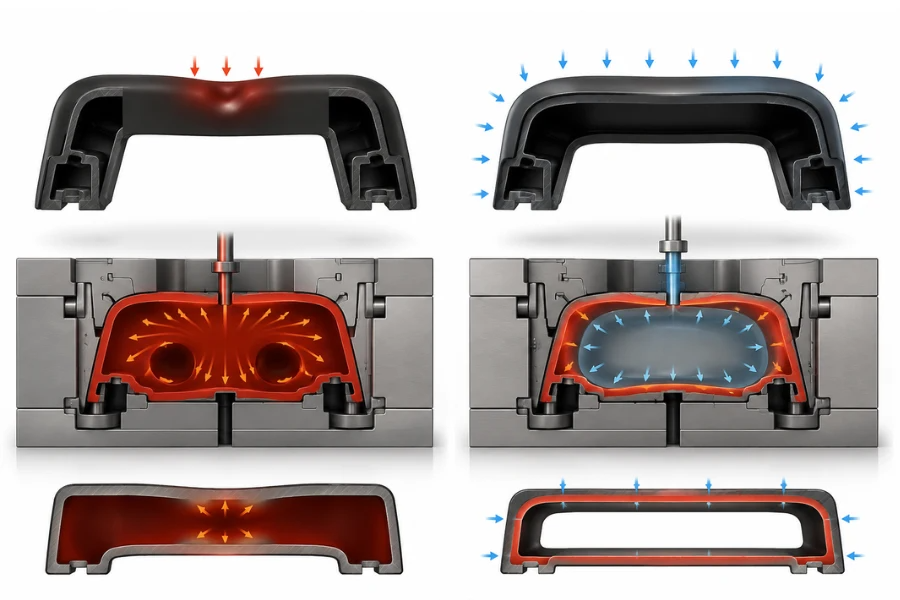
What is gas-assisted injection molding?
Gas-assisted injection molding is an advanced injection molding process. After injecting a certain amount of resin into the mold cavity, high-pressure inert gas (almost always nitrogen) is injected into the molten polymer.
According to standard injection molding principles, the mold cavity is first filled with a precisely measured amount of molten polymer, rather than injecting all of it at once. Then nitrogen is introduced through a special gas nozzle or gas needle. As the gas passes through the molten core, it pushes the polymer toward the mold walls while acting as an internal filler. After cooling, the gas is released before the finished part is ejected.
Unlike traditional injection molding, where holding pressure relies entirely on keeping the gate open, gas-assisted injection molding creates an independent pressure source inside the part.
The pressure transfer path changes from:
Injection unit → Gate → Polymer
To:
Nitrogen → Hollow core → Polymer → Mold surface
This engineering difference fundamentally changes how shrinkage is controlled.
Nitrogen doesn’t stop applying pressure when the gate freezes; it continues to deliver pressure for most of the cooling cycle, greatly improving shrinkage compensation.
Modern gas-assisted molding processes usually include two main configurations:
Internal gas-assisted injection molding introduces nitrogen directly into the molten polymer, forming continuous hollow channels that reduce weight while maintaining structural rigidity.
External gas-assisted injection molding introduces gas between the polymer and the mold surface. Unlike forming hollow channels, this process mainly improves appearance by preventing sink marks and maintaining excellent surface replication.
Nitrogen is used because it has several engineering advantages:
- Chemically stable
- Dry
- Non-flammable
- Stable under high pressure
- Easy to recover and reuse
- Does not react with molten polymers
These characteristics make nitrogen more suitable for precision molding applications than compressed air.
How does gas-assisted injection molding work?
Although the process looks simple, successful gas-assisted molding depends on the interaction between polymer rheology, cooling behavior, cavity geometry, gas timing, and pressure distribution.
Each stage affects the stability of the hollow channels and ultimately determines product quality.
Step 1: Partial Injection
Unlike traditional injection molding, the cavity is intentionally not fully filled.
Instead, engineers inject a carefully controlled short shot, which is optimized through DFM analysis and mold validation.
Determining the correct shot size is one of the most important engineering decisions in the entire process.
If the shot size is too large:
- Gas penetration becomes unstable.
- Hollow channels become irregular.
- Material savings decrease.
If the shot size is too small:
- Nitrogen may break through the advancing melt front.
- Cosmetic defects increase.
- Completely filling voids may become impossible.
Experienced manufacturers don’t rely on a fixed cavity volume percentage. Instead, they determine the optimal shot size through mold trials, cavity pressure analysis, and production validation.
Step 2: Nitrogen Injection
Once the required shot volume enters the cavity, high-pressure nitrogen is injected through a dedicated gas needle or nozzle.
Modern gas-assisted molding systems rarely run at constant gas pressure.
Instead, programmable controllers manage multiple pressure stages, including:
- Initial gas pressure
- Gas delay time
- Packing pressure
- Hold pressure
- Pressure decay
Optimizing these parameters allows engineers to achieve stable gas penetration while minimizing appearance defects.
Step 3: Gas Penetrates the Molten Core
This stage sets gas-assisted injection molding apart from all traditional molding processes.
Nitrogen does not move randomly through the polymer.
Instead, it naturally moves along the path of least resistance.
When the molten polymer contacts the relatively cooler mold surface, it rapidly solidifies, forming a frozen layer with much higher viscosity.
Meanwhile, the temperature at the center of the flow path remains high, keeping the viscosity much lower.
This creates a viscosity gradient across the wall thickness.
Cold mold surface ↓ Frozen skin layer (high viscosity) ↓ Transition layer ↓ Molten core layer (low viscosity)
Since gas naturally flows through areas of least resistance, nitrogen passes through the molten core while keeping the already solidified surface layer intact.
This behavior creates the characteristic hollow channels in gas-assisted molded parts.
Unlike many simplified explanations, gas penetration is not determined solely by gas pressure.
It is controlled by the interaction of the following factors:
- Melt viscosity
- Cooling rate
- Pressure gradient
- Wall thickness
- Flow resistance
- Polymer rheology
- Cavity geometry
This explains why two parts molded at the same gas pressure can end up with completely different hollow channel structures if their geometries are different.
Step 4: Gas Filling
Once the hollow channels are formed, the nitrogen acts as the internal filling medium.
This stage fully demonstrates the biggest engineering advantage of gas-assisted injection molding.
Traditional molding process:
Hydraulic seal ↓ Gate freeze ↓ Sealing complete ↓ Core material continues to shrink ↓ Sink marks
In gas-assisted molding:
Polymer cooling ↓ Volume shrinkage ↓ Nitrogen maintains internal pressure ↓ Polymer clings to mold surface ↓ Reduced sink marks ↓ Lower residual stress ↓ Improved dimensional stability
Because nitrogen can maintain pressure independently of gate freeze, shrinkage compensation continues for most of the cooling process.
This mechanism explains why gas-assisted molding performs particularly well for products with thick ribs, structural bosses, and large decorative surfaces.

