

Gas-assisted injection molding and water-assisted injection molding are both hollow-assisted injection molding techniques. Both processes can address common industry issues like sink marks in thick-walled plastic parts, high internal stress, long molding cycles, and high material usage. The principles of the two methods are similar since both use a medium to assist hollow molding. The difference lies in the physical properties of the medium, which leads to significant differences in cooling capability, molding quality, mold requirements, compatible materials, and the range of products that can be made. Knowing the pros and cons of each process helps you choose the right molding method during product development, reducing production costs and stabilizing the quality of the plastic parts.
-
Process molding principle
-
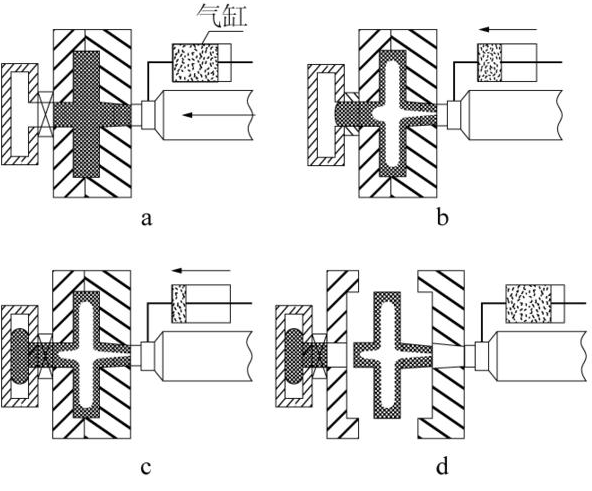
Gas-assisted injection molding uses high-pressure inert nitrogen as the assist medium. During injection, 70% to 90% of the cavity is first filled with molten plastic, then high-pressure nitrogen is injected into the melt through a special gas needle. The gas pressure pushes the melt to fill the cavity further while forming a stable hollow channel inside the part. During the gas holding stage, the gas compensates for melt shrinkage, and after the cavity cools, the gas is released for demolding. Gas is compressible and flows well, adapting to irregular bent channels, and it doesn’t cause corrosion or hydrolysis of the plastic material.
-
Water-assisted injection molding uses high-pressure pure water as the assist medium. At the early stage, the melt is injected in a set amount, then high-pressure water is injected into the melt. Using water's incompressibility, the melt is pushed to fill the mold. Water conducts heat much better than gas, allowing quick and forced cooling of the inner walls. After molding, compressed air removes the remaining water, completing pressure holding and demolding. Water cooling is extremely efficient with more uniform wall thickness, making it more suitable for simple, straight hollow plastic parts.
II. Comparison of Core Performance of the Two Processes
-
Cooling Performance Differences
Gas-assisted injection molding relies on nitrogen to maintain internal pressure. Since gases have low thermal conductivity, the cooling speed inside the part is slow, and the overall molding cycle can only be optimized to a limited extent, shortening production time by about 10% to 30%. Water-assisted injection molding, on the other hand, has excellent thermal conductivity, far exceeding that of nitrogen. The cooling speed of the internal walls is greatly improved, and the overall molding cycle can be further shortened compared to gas-assisted molding, making it especially efficient for thick-walled products. -
Quality of Internal Wall Molding
Gas-assisted molded parts have rough internal wall textures, prone to wavy lines and gas retention marks. The uniformity of hollow wall thickness is generally moderate, making it unsuitable for forming smooth inner walls in tube-like products. Water-assisted molded parts have smooth and even internal walls, without ripple or uneven defects. Hollow wall thickness is uniform and stable, which helps reduce fluid transport resistance and is well-suited for precise pipeline plastic parts. -
Material Compatibility
The gas used in gas-assisted injection molding is chemically stable and compatible with most common and engineering plastics, including some plastics that are sensitive to hydrolysis, offering broad material compatibility. In water-assisted molding, the plastic directly contacts water during processing, making it unsuitable for water-absorbent or hydrolysis-sensitive plastics. It is only suitable for chemically stable crystalline plastics, placing stricter limits on material selection. -
Mold and Equipment Requirements
Gas-assisted molding has a simple mold structure and low sealing requirements. Standard mold steel is sufficient, equipment costs are cheap, the technology is mature, and maintenance is easy. Water-assisted molding requires high-strength seals, high-precision needle valves inside the mold water channels, and corrosion-resistant coatings on cavity surfaces. Equipment and manufacturing costs are higher, and post-maintenance is more complex.
III. Suitable Production Scenarios for Gas-Assisted Injection Molding
Gas-assisted injection molding is highly versatile and works well for hollow parts with complex and irregular shapes. Products with curved or irregular structures and handles with varying thicknesses are best suited for gas-assisted molding because the gas flows easily through complicated channels without leaving media residues. For home appliance shells or automotive interior parts requiring high appearance quality, gas-assisted molding avoids water flow marks and keeps surfaces smooth and clean. Large support structures with varying thicknesses can benefit from gas-assisted molding to eliminate surface sink marks, reduce internal stress, and prevent deformation or cracking later. Specialty plastics that are hydrolysis-sensitive or highly water-absorbent must use gas-assisted molding to avoid performance loss from water contact.

