

Gas-assisted injection molding is an innovative molding technology developed on the basis of traditional injection molding. Its core concept is that after the plastic melt is injected into the mold cavity, high-pressure inert gas (usually nitrogen) is injected into the melt. The gas pressure pushes the melt to complete filling, holding, and cooling, eventually forming an internal air channel within the product. This preserves the product's exterior appearance while optimizing its mechanical properties, meeting some of the lightweight requirements. This article, combining technical documents and practical cases, explores the logic of gas-assisted injection molding from three dimensions: product structural design, key points of process control, and critical mold design.
01
Process Principles and Flow
Gas-assisted injection molding is a precise timing control process, mainly divided into the following five stages:
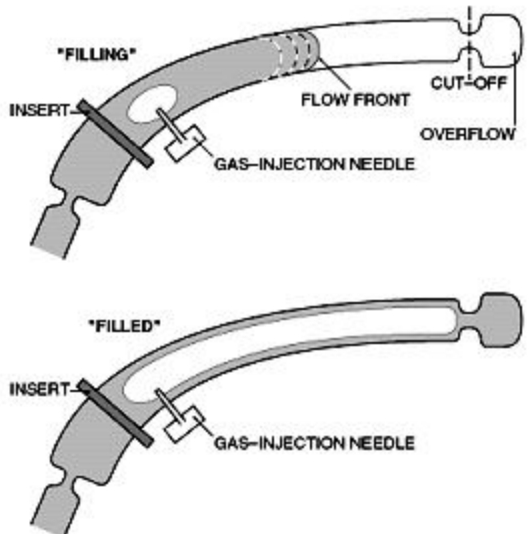
Melt Injection (Short Shot)
Inject a certain amount of plastic melt into the mold cavity, but not fully fill it, usually 60%-95% of the cavity volume (traditional injection molding fills 100%). This ratio is crucial and is called the "short shot amount." Too much melt leaves no room for the gas to penetrate, which may cause gas breakthrough or surface gas marks; too little melt means the gas cannot push the melt to fill the cavity, resulting in incomplete filling. The "pressure gradient test" must be used. Start with a high short shot amount, gradually reduce the injection amount, and observe gas penetration, to find the best switching point that both fills the cavity and creates full, even air channels. This point usually corresponds to the most stable process window.
Inject High-Pressure Gas (Gas Penetration)
After or simultaneously with melt injection, high-pressure nitrogen (pressure usually higher than the melt pressure) is injected into the melt through a gas needle.
The gas moves along the path of least resistance (usually thick walls or ribs), pushing the melt toward the end of the cavity until it is fully filled.
Gas Holding Pressure
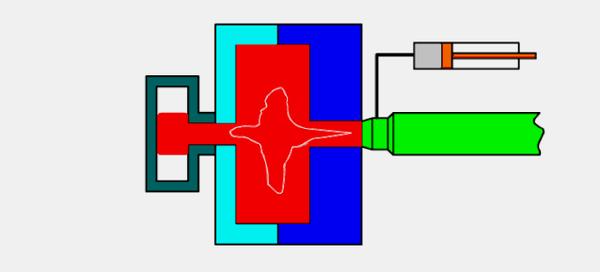
After the cavity is filled, the gas pressure is kept constant, entering the holding stage.
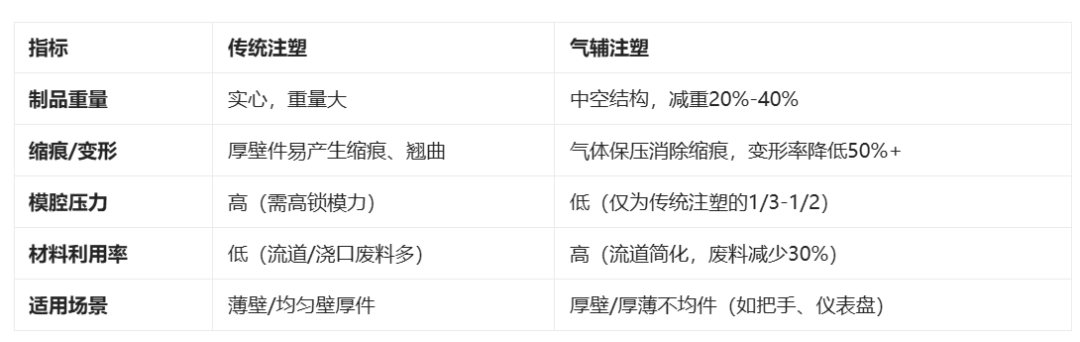
During this stage, the gas continuously applies pressure from the inside out, making up for the volume shrinkage caused by the cooling of the melt, ensuring the product's surface sticks closely to the mold, and eliminating sink marks.
This is where it’s fundamentally different from traditional injection molding 'melt holding pressure'—the pressure is more even and the internal stress is lower.
Gas Depressurization and Recovery
After the product cools and solidifies, release and recover the gas for reuse to reduce costs.
Mold Opening and Product Removal
Open the mold and eject the product with internal air channels.
02
Key Advantages
Compared to conventional injection molding, gas-assisted injection molding offers notable benefits:
Significantly Reduces Internal Stress and Warpage
Traditional injection molding cavity pressures can reach 30~50 MPa, while gas-assisted injection molding is only about 5 kPa. The pressure on the product is drastically reduced, resulting in minimal residual stress and much less warping.
Reduces Clamping Force and Injection Pressure
With internal gas aiding in filling and holding, the required injection pressure and clamping force can be reduced by 30%~60%, making it possible to use smaller injection machines for large products.
Saves Raw Material
The product forms a hollow interior, saving 20%~40% of the plastic, directly lowering material costs and reducing product weight.
Enhanced Forming Capability
Can shape large, thick-walled, uneven-wall, and complex-shaped products in a single molding, addressing shrink marks and incomplete filling issues that are tough with traditional molding, greatly increasing design flexibility.
Improves Surface Quality
Gas holding helps eliminate surface sink marks, resulting in smooth, premium-grade surfaces.
Shortens Molding Cycle
The hollow gas structure reduces the amount of plastic that needs cooling. Since gas is also a good conductor of heat, it accelerates internal cooling, shortening the overall cycle.
Increases Product Rigidity and Strength
Thick-wall areas form hollow rib structures like an "I-beam," saving material while boosting the product's specific strength (strength-to-weight ratio) and stiffness.
03
Key Points in Product and Mold Design
To successfully apply gas-assist technology, design is crucial:
Gas Channel Design Principles
Cross-sectional Shape: The gas channel cross-section should ideally be close to circular, avoiding sharp corners, and use large radius transitions to prevent melt accumulation in corners.
If a rectangular shape is necessary, the gas channel is usually designed as an ellipse. To ensure even gas penetration, the channel should meet b ≤ (3~5)h (where b is the channel width and h is the wall thickness of the product).
Gas channels should be arranged along the main stress direction of the product or at the end of melt flow, forming a continuous and balanced gas passage network.
Shrinkage Prevention Design
At the contact points between the gas channel and thin walls of the product, avoid rounded transitions. Instead, provide shrinkage prevention grooves to guide gas and prevent sink marks.
Gate and Gas Needle Position
Gate positions should facilitate melt filling and gas penetration. Gas needle positions are usually set at areas where the melt fills first or at thick-walled sections.
Prevent gas from entering thin-walled areas of the product or breaking through the melt surface.
04
Main Application Areas
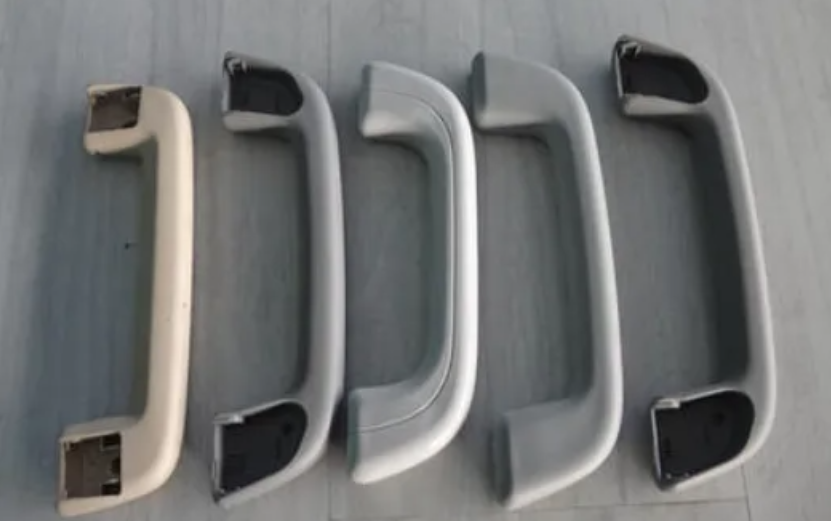
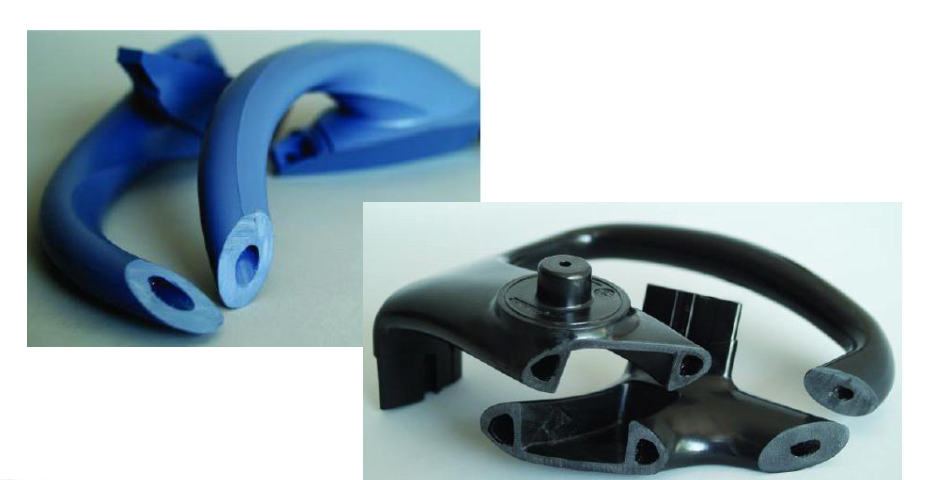
Gas-assisted injection molding is particularly suitable for producing thick-walled, ribbed, large plate-shaped hollow or partially hollow products.
Automotive field: door handles, roof handles, door armrests, etc.
Automotive: bumpers, dashboards, steering wheels, etc.
Home appliances and daily necessities: chair armrests, bases, large toys, office furniture parts, panels, etc.
05
Common Issues in Gas-Assisted Injection Molding and Quick Troubleshooting Ideas
06
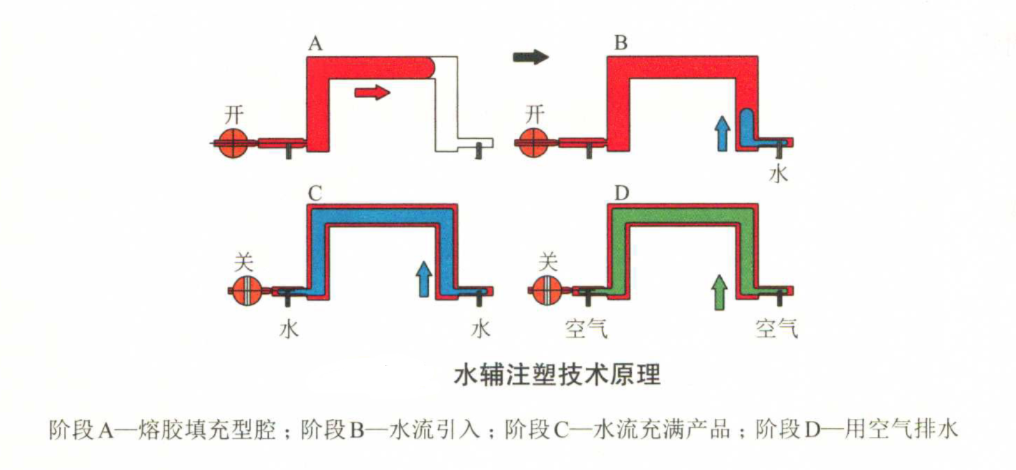
Technical Extension: Water-Assisted Injection Molding
Principle: Similar to gas-assisted, but uses water as the auxiliary medium.
Advantages: Water has a high specific heat capacity, making cooling extremely efficient, which can shorten cooling time by up to 75%.
It can produce thinner, more uniform product walls, saving more material.
The inner walls of products are smoother.
Lower cost.
07
Summary
Action list for technicians:
Be sure to do the pressure gradient test to find the optimal shot volume and gas pressure curve.
Remember ‘plasticize first, then gas.’ Adjust the melt temperature and injection speed first, then tweak the gas parameters.
Cut open the first part to check whether the runner shape and position match the design—this is the gold standard for process health.
Actively report runner and venting issues encountered during production to push for mold optimization.
Nitrogen can be recycled, so check the pipeline seals to save costs.
The charm of gas-assisted processes is using ‘smart force’ instead of ‘brute force.’ Master it, and you can produce higher-quality, more complex products with smaller machines, less material, and shorter cycles. It’s not just a technique—it’s an art.

